Wednesday, April 24, 2019

5th Miscellaneous Article

Fallout 76. Windows PC Version, Bethesda Softworks, 2018.

Makuch, Eddie. “Fallout 76 Has Microtransactions, But Bethesda Insists It's Not Pay-To-Win.” GameSpot, Gamespot, 30 Oct. 2018, www.gamespot.com/articles/fallout-76-has-microtransactions-but-bethesda-insi/1100-6462850/.

To be honest NetherRealm studios is at least trying to reflect upon and improve their game, Bethesda is just letting it crash and burn. This game started out as trash and has gotten no better from the numerous "patches". Things supposed to be fix are still problems and the game is just bad but something irks me more than the state of the game, it's the microtransactions. In the past (release of the game) Bethesda's vice president Pete Hines said," All the content we ever put out for Fallout 76--all the DLC, all the post-launch stuff--is going to be free. That's important. And to say, the Atomic shop is cosmetic stuff. To make sure folks understand--look there's a line. There are people who have crossed it, but we're going to stay on the right side of it (This is the GameSpot citation)." Hines referring to the "right side of it" is concerning what previous developers had done to their games with pay-to-win micotranscations. Funny thing is and of course to no ones surprise they later did go back and begin putting non-cosmetic items within the atoms shop. This is a big problem because Fallout 76 is a online only game meaning these items have a tangible affect on everyone, the defention of pay-to-win. Their so called "right side" and "only cosmetic stuff'" was a downright lie, destroying the already fractured trust between them and their player base. Its as if they are kicking an already dead horse, what to they have to gain? Gamers optimism of a hopeful future especially as Skyrim 6 and Starfield were announced, were suddenly clouded with dread and sadness as the prospect of this could happen to all of their future releases. As constantly said throughout the Star Wars movies, I have a bad feeling about this.

4th Miscellaneous Article

Mortal Kombat 11. Windows PC Version, NetherRealm Studios, 2019.

Mortal Kombat 11 released on April 23rd, to both a wave of compliments but also a flood of mass criticism directed at one particular portion of the game. This criticism lies in within the Krypt and the challenge towers of time. On the PC version (Steam version) the player reviews are at a mixed rating. This means it is roughly half and half on negative and positive but this is because time passed allowing more reviews. On the first day of its release it was review bombed (large groups of people leave negative user reviews online in the hopes of getting attention) because of the massive grind wall. The Krypt is a place where players can open up chests that will RANDOMLY give items like artwork, skins , and consumables. At first glance this is not a problem but players soon realized the horrid flaws in the system. This is a fighting game which means it has a selection of characters to chose from, in this case 19 characters. Not every player will want to play all of these characters instead selecting a few like 2 to 3, can you image the frustration within the Krypt as they constantly open up chests that give them items for characters they will never play. Not to mention the different types of chest having up to three different currencies that are increasing harder to get (Coins, Souls, Hearts). But this is not the worse of it, these challenge towers leave a very sour mouth in players. They are straight up unfair giving the AI massive advantage on every difficulty. Mind you these towers are main method of a way in game to earn the different currencies, as broken as they are. If the intent is not clear then allow me to spill it out, NetherRealm studios seeks to frustrate players with the unbalanced towers and RNG Krypt to push players to go buy the currencies to unlock the stuff they actually want. Its sad that this studio has also fallen victim to the microtranscations trend but luckily they seem to generally care and are beginning to balance things out reducing the grind, a good start. While NetherRealm studios seem to care about the future of their game another studio called
Bethesda would rather see their game crash and burn from their lies.

Tuesday, April 23, 2019

4th Academic Article

Dufault, Jackson. "DUFAULT: Video game microtransactions unethical." UWIRE Text, 5 Dec. 2017, p. 1. Infotrac Newsstand, http://link.galegroup.com/apps/doc/A524310222/STND?u=auraria_main&sid=STND&xid=3cdc5fff. Accessed 24 Apr. 2019. -(Academic Article)


Potato, Hotter. “r/StarWarsBattlefront - It Takes 40 Hours to Unlock a Hero. Spreadsheet and Galactic Assault Statistics.” Reddit, 2018, www.reddit.com/r/StarWarsBattlefront/comments/7c6bjm/it_takes_40_hours_to_unlock_a_hero_spreadsheet/. -(Reddit post)

In the spirit of the idea that microtranscations are a central feature and not just a side option like said by the commenter's quote in my last post, we look back at the beginning of this mess. The only reason microtranscations began to get media attention and the governments intervention is because of one specific game and just how hideous its micotranscations were. It all began with Star Wars Battlefront 2, the company that made it are the ones we know and love EA (Electronic Arts). But why did this game get national attention and not say the sport games that came before as they also had microtranscations? Well that because of just how insidious they were implemented. They were the central feature of the whole progression system, they dictated how a player got their items and equipment (new characters like Darth Vader too) in the game. This academic article that I found in the Auraria Library's database describes perfectly how this system was seen by the gamers,"An EA developer's response on Reddit became the most down-voted comment in the history of the website. But it doesn't end there. It was reported that EA lost nearly $3 billion in stock value after the backlash." A $3 billion stock drop was the result of this system, in short a lot of money lost. This system stalled the progress of the entire game, paywalls behind every turn. Credits (the systems currency) was given out in small doses, nowhere near enough to pay for the all the lack luster cosmetic items let alone the ironic characters of the Star Wars name. A Reddit user by the name of HotterPotato calculated it would take a dedicated 40 hours straight to unlock a hero that was 60,000 credits. The progression system put it had the intention of slowing everything else down in order to encourage people to spend microtranscations. After all why play for 40 hours when you can just give them 5 bucks, a devious way to try and get even more money. Luckily the game tanked and did damage to EA as whole as well as spreading the message that microtranscations are a real problem. But what other games have problems like this? Recently as in today (April 23rd) a game released called Mortal Kombat 11, it is kicking up a serious storm because of its microtranscations.

Boolean Search

Alexandra, Heather. “Activision Patents Matchmaking That Encourages Players To Buy Microtransactions.” Kotaku, Kotaku, 17 Oct. 2017, kotaku.com/activision-patents-matchmaking-that-encourages-players-1819630937.

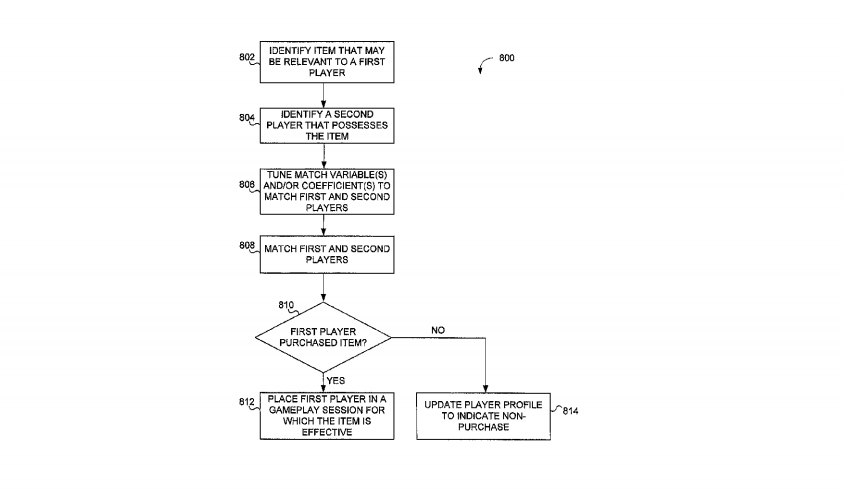
All the way back in 2015 Activision filed a patent in an effort to increase microtransactions revenue. I found this article by using a Boolean search typing in mircrotranscations and patents. To everyone's horror the patent  was approved in October 2017. This patent as stated by the Kotatku article written by Alexandra Heather says," A patent granted to Activision outlines a new matchmaking system that would pair players together in order to encourage microtransactions." Yet another underhanded attempt to try and swindle money from players wallets. The below picture is a simple way of understanding the system. It starts out by finding an interesting item that player 1 would value (is relevant to them), then it would find another player with this item paring them together in a game session. From this session the system would see if the first player would go and purchase this item. If they do it puts them in another game session where the item is "effective", another word for this is overpowered or broken. The system could put a player in lower skilled lobby enabling him to destroy the competition, this player might get the feeling that buying more stuff will continue this trend. If he doesn't buy this item it states his profile gets updated, probably thinking the item wasn't as enticing to the player keeping this data somewhere for future use. Its horrifying that this system occurs in the background with no knowledge given to the player. Every game can be artificially setup to encourage microtransactions, players with broken weapons and out of frustration that player might go and buy this weapon. Throwing them into another game where they have the broken weapon and again piss someone off enough to buy that weapon again. An endless cycle of misery and disgust. But I feel as if the best quote to summarize this was made by a commenter on the Kotaku article named  Taliesin Merlin," Just the latest reminder that microtransactions aren’t separate from the game. They can be central to the game itself, in mechanics designed to trigger further purchases."


Monday, April 22, 2019

3rd Academic Article

King, Daniel L., and Paul H. Delfabbro. “Predatory Monetization Schemes in Video Games (E.g. ‘Loot Boxes’) and Internet Gaming Disorder.” Addiction, vol. 113, no. 11, 2018, pp. 1967–1969., doi:10.1111/add.14286. -(Found in the Auraria Library database)

My search into the schemes of microtransactions led me to find this article in a addiction journal. Written by Daniel and Paul in 2018 they go over the predatory monetization schemes within video games like microtransactions. The quote that caught my eye was the first thing I saw saying," Predatory monetization schemes in video games are purchasing systems that disguise or withhold the long‐term cost of the activity until players are already financially and psychologically committed." This quote really sums up what loot boxes and the rest of microtransactions are. For a short term gain whether it would be a cosmetic or a game play changing item they withhold information regarding the long term cost. Once the player has become committed to the game, this leds to the concept of entrapment. Which the article sums up very well," The belief that one has invested too much to quit. In situations of this nature, players will often spend an escalating amount of money that begets further spending on the game." Companies seek to make players psychologically and financially addicted to their game in the hopes they spend even more increasing sums of money. Typically these people are called "whales" in the gaming community, spending vast sums of money on in game items. This is disastrous for the players and if it continues more and more people (including children) will become affected.  But this is not the end, as time goes on more and more time and effort is put into developing new ways to take money out of gamers wallets. One of the worse companies to try this is Activison trying to get a patent to further the schemes of psychologically manipulating players.

3rd Miscellaneous Article

Zendle, David, and Paul Cairns. “Video Game Loot Boxes Are Linked to Problem Gambling: Results of a Large-Scale Survey.” PLOS ONE, Public Library of Science, 21 Nov. 2018, journals.plos.org/plosone/article?id=10.1371%2Fjournal.pone.0206767.


This study came out in 2018 to establish whether or not there was a relationship between gambling and loot boxes. I came across this study when I had found the other one about Belgium banning loot boxes in its state, using this survey for a piece of evidence. This survey was conducted across Reddit and its many subreddits asking gamers (or just people in general). They managed to pull in over 7,422 responses. When it came to the conclusion they said,"This research provides empirical evidence of a relationship between loot box use and problem gambling. The relationship seen here was neither small, nor trivial. It was stronger than previously observed relationships between problem gambling and factors like alcohol abuse, drug use, and depression." With their responses they came to the conclusion that there was a link, a more casual relationship between the two. People who are already problem gamblers  tend to spend more on loot boxes because of the similarities, the lack of control and excess in spending may apply to loot boxes too just as it to regular gambling. Even in this study they said,"We believe that the strength and direction of this relationship indicates that regulation of loot boxes is appropriate and necessary." Many other people clearly agree with the regulation and even have this study to back it up. This and many other pieces of evidence including Belgium's own investigation into the matter ultimately led up to the decision to ban loot boxes in their country. Hopefully this trend will continue on as more and more people are beginning to see the extent of the problems caused by microtransacations.

Sunday, April 21, 2019

2nd Academic Article

Baker, Kelly. "The problem with microtransactions." UWIRE Text, 22 Oct. 2018, p. 1. Academic OneFile, http://link.galegroup.com.aurarialibrary.idm.oclc.org/apps/doc/A559278634/AONE?u=auraria_main&sid=AONE&xid=7cd4d6fc. Accessed 21 Apr. 2019.

To elaborate on the last post concerning the particular company which refused to comply with the new Belgium law about gambling and microtransactions is of course EA. I found this academic article by Kelly which gave more details about the matter,"Video game companies have had the gaul to try to refute these new laws by refusing to comply and even encouraging players to speak out in their defense to the Belgian government by saying that the microtransactions the companies are implementing are simply "not gambling." These video game companies Kelly refers to are EA and 2k Games. While 2k Games has complied with the decision made by Belgium, they tried to convince their customers that it wasn't gambling. On the start up of the loading screen of NBA 2K19 in the Belgium and Netherlands version it says,"We will be continuing conversations with BGC in order to explain our view on how NBA 2K…already [complies] with local laws. If you agree, we recommend that you contact your local government representative to communicate your opinion.” Its sad a multi million dollar company is pleading with its audience to try and reverse a decision that helps gamers because they want to stuff their pockets with that much more money. EA though is much worse because they outright refused to comply with the new law saying simply,"We don't believe that FIFA Ultimate Team or loot boxes are gambling." They claimed that its not gambling because players always receive a specified number of items in each pack. This arguments falls apart when people realize that because its a loot box you never know what you will receive (its random) and some items might be worth a lot more in-game. Luckily as of January 31st ,2019 EA has stopped accepting real money for in-game currency. This is a very good thing and shows if people truly don't want something and enough attention is given to it in the form of public backlash change can occur. But how did this fiasco all start? Well we can see it in studies that released back in 2018 that revolved around this relationship of gambling and microtransactions.